KEYNOTE ADDRESS MINISTER OF STATE FOR TRADE – GENERAL WILSON MBASU MBADI
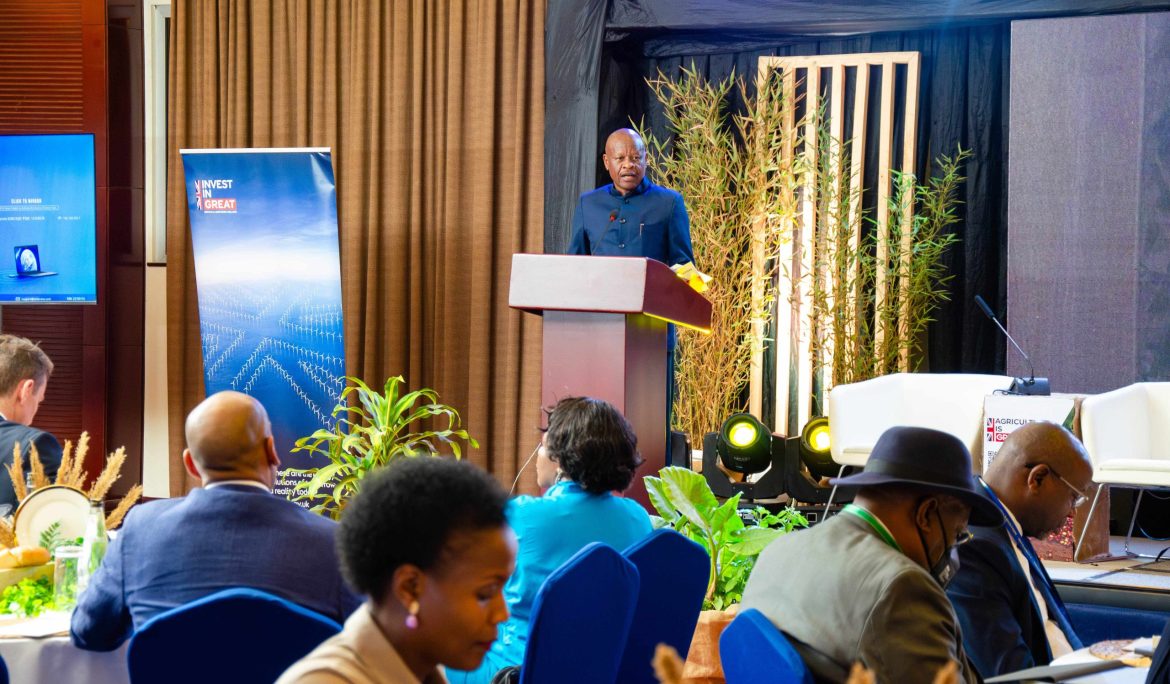
Unlocking Uganda’s Agricultural Potential: Opportunities for UK-Uganda Collaboration.
Your Excellency, Lisa Chesney, British High Commissioner to Uganda
Maj. Gen. David Kasura Kyomukama – Permanent Secretary, MAAIF
UK Business Community Present
Chief Executive Officers
Government Officials Present
The Business Fraternity
Distinguished Guests,
Ladies and Gentlemen.
It is an honor to address this esteemed gathering of policymakers, business leaders, and experts in the agricultural and export sectors. Today, we gather to explore opportunities for collaboration between the UK and Uganda in the agricultural sector, a vital sector that holds immense potential for economic growth and development in Uganda.
Uganda’s agricultural sector is the backbone of our economy, employing over 70% of our workforce and contributing significantly to our GDP. Our fertile soils, favorable climate, and hardworking farmers make us an ideal location for agricultural production. This requires accessibility to markets, appropriate technology, and affordable finance if full potential of this sector is to be realized.
Agro-industrialization Programme is a key component of Uganda’s National Development Plan IV (NDP IV), Ten-fold growth Strategy and is among the four key priority accelerator actions for achieving the Ten-fold economic growth [Tourism, mineral based Industrial Development and STI incl ICT & Creative Art (knowledge economy)]-ATMS. The aim of Agro-Industrialization is to increase commercialization and competitiveness of agricultural production and agro-processing. The Programme seeks to Propel Uganda to reduce its negative trade balance by adding value to agricultural raw materials, promoting export expansion of high value products and import substitution.
Uganda’s agricultural sector has huge potential for growth and currently accounts for 40% of merchandise exports. Agricultural exports over USD $ 2.2 billion annually. If we add value to our products and double their value, we can increase our export earnings to USD$ 20 billion by 2040 which translates into USD $51 billion to our GDP as per the 10-fold growth strategy. By focusing on value addition and export expansion, we can unlock the full potential of our agricultural sector and drive sustainable economic growth, the reason Government (and partners like UK) is working on:
- Facilitating the process of access to credit for small farmers at affordable costs, increasing long-term capital for SMEs to support agro-industrialization.
- Facilitating vertical and horizontal value addition to support production of high-value multi-input products like nutritional foods, baby foods etc. That use several products like milk, eggs, maize, vegetables, fruits, etc.
- Improving agricultural production, productivity and profitability especially through provision of fertilizers, quality seeds and seedlings for better yields per acreage.
- Supporting farmers to access micro-scale irrigation systems.
- Implementing of the warehouse receipt system (WRS) to help in sensitization, education, financing, transportation and aggregation, storage, quality standards, and linkage to markets.
- Effective enforcement and implementation of the rules and regulations to support exports, such as beef, horticulture and other agricultural products.
- Implementation and mainstreaming of climate change mitigation strategies.
- Diversifying the sources of electricity and invest in expanding the geographical coverage to support agro-industrialization.
- Availing water for crop and animal use.
The United Kingdom and Uganda have a long history of cooperation in the agricultural and Trade sectors, and I believe that our partnership can be taken to the next level. Uganda’s exports to UK stood at USD $ 28m against USD $ 71m in 2024 (international trade centre). Uganda’s major exports to UK are Coffee, tea, spices, fruits and vegetables and flowers and imports Pharmaceuticals, Electricals, Beverages and Spirits, machinery among others. The UK’s expertise in advanced agricultural technologies and services can help us improve productivity, quality, and competitiveness.
As you already know, Uganda is the lead exporter of Coffee in Africa and among the seven (7) global exporters. The coffee exports have contributed16- 20% of the export revenue for the last 20 years and as of June 2024, exports of coffee reached 7.8million bags generating USD $ 2.2 billion and employing 12.5 million people (Ministry of Agriculture Animal industry and Fisheries Raw Data Base 2025). We hope to continue to drive coffee exports amidst the ongoing global dynamics on deforestation requirement. We hope to diversify our export portfolio and brand to tap into UK market.
Moving forward, our collaboration can therefore focus on:
- Trade Policy implementation: Allow me to appreciate the contribution of the United Kingdom in financing the review of Uganda’s National Trade Policy and National Export Strategy. The Policy documents have undergone wider stakeholder consultation and today the technical team will unpack the details of the Policy and Strategy.
Uganda’s revised National Trade Policy outlines a forward-looking and inclusive framework designed to transform the trade sector into a dynamic engine for sustainable economic growth. In line with the Vision of a competitive Ugandan trade sector that is fully integrated into regional and global markets, the Policy seeks to effectively respond to evolving domestic priorities and international trade dynamics.
The Revised National Trade Policy reinforces the importance of strengthening Uganda’s domestic market while aggressively expanding and diversifying exports, particularly of manufactured goods and services. It recognizes that enhancing trade performance is essential for job creation, poverty reduction, and national resilience in the face of global economic shifts and climate-related challenges
As you all know, Uganda first qualified for UN graduation from the least developed economies in March, 2024. We are currently undergoing assessment for the second review in 2027. During this transition, Uganda needs to demonstrate sustainability of our development trajectory in key sectors of trade, health and education. Including demonstrating resilience to climate, economic and global external shocks.
The National Trade Policy and National Export Strategy therefore prioritize inclusivity, sustainability and resilience, ensuring that the benefits of trade are equitably distributed across our society. I am confident that trough collective effort and strategic implementation, we can unlock Uganda’s potential and drive sustainable economic growth.
As Uganda continues to enjoy the UK scheme for least developed countries that allows zero tariffs on everything but arms/ammunition, we hope to have simpler or generous rules of origin package that allows our products integrate into regional and global value chains. This will facilitate market access for our exports and assist us have a smooth transition period following our graduation process.
- Value Chain Development: We can work together to develop efficient value chains that benefit both our countries. UK companies can invest in Uganda’s agricultural sector, and we can work together to improve access to markets, both domestically and internationally. The key priority value chains center around coffee, Maize, beef, milk, Cotton, tea, fish, cocoa, cassava and palm oil. Targeted investments in manufacturing plants for Maize, fish, feeds, coffee. Uganda offers opportunity for investing in Export Processing Zones (EPZs) and agro-industrial parks in key production corridors, alongside supporting value addition facilities for coffee, fish, maize, cocoa, and other manufactured products in order to boost competitiveness in regional and global markets.
- Technology Transfer: The UK’s advanced agricultural technologies can help us improve productivity and quality. Increasing investment in research and development will harness Uganda’s potential for productivity and resilience across agriculture value chains. We can work together to transfer knowledge and technologies that can benefit our farmers and agribusinesses. We look forward to strategic investments in a combined abattoir and beef processing facility, Packaging facilities and cleaning equipment; advanced technologies for beauty products and compliance technologies for dairy products among others.
- Harnessing Uganda Airlines Direct Flights to UK: The flights have and will continue to facilitate the swift movement of people, goods and services to the UK Market. More Importantly on the Cargo transport, the airline will ease the export of Ugandan products like fish, coffee, fruits, and vegetables to the UK market and further facilitate UK investors and tourists to Uganda. Thus, easing logistical barriers and promoting economic growth.
- Capacity Building: We can collaborate on capacity-building programs that can help our farmers, extension workers, exporters, processors and policymakers develop the skills they need to compete in the global market.
Our collaboration can benefit both our countries in increasing trade values, creating new opportunities for businesses and farmers. The Agro-industrialization agenda will create jobs and income opportunities for our citizens, contributing to a shared economic growth and poverty reduction.
I thank UK for continuously working with Uganda to reduce trade barriers in order to strengthen economic ties. This UK has done through:
- Trade Facilitation: The UK’s support through TradeMark Africa (TMA) has helped reduce the cost and time of trading across borders. TMA has set up 15 one-stop border posts (OSBPs) across East Africa, with six in Uganda, reducing border crossing times by an average of 70%.
- – Digitalization: The UK has supported the development of digital trade systems, such as the Uganda Electronic Single Window, which streamlines import and export processes, reducing time and transactional costs.
- Customs Modernization: The UK has assisted in modernizing Uganda’s customs systems, including the implementation of the ASYCUDA World System, which enhances the ease of doing business.
- – Investment Promotion: The British Chamber of Commerce in Uganda (BCCU) was launched to promote trade and investment links between the UK and Uganda. The BCCU aims to reduce barriers to entry and increase trade and investment.
- For Uganda, we have established direct flights to London. This is expected to boost trade, tourism, and investment between the two countries, thus easing logistical barriers and promoting economic growth.
- On Development Partnership: The UK’s development partnership with Uganda focuses on driving clean, green, inclusive growth and mutual prosperity. The UK has invested over £800 million in Uganda through the British Investment Partnership portfolio.
These initiatives demonstrate the UK’s commitment to supporting Uganda’s economic growth and development, and to strengthening trade ties between the two countries.
In conclusion, I believe that the UK-Uganda Agro-Industrialization Forum is a significant step towards strengthening our economic ties and promoting growth and development in Uganda’s agricultural sector.
I look forward to working with our UK partners to explore opportunities for collaboration and to develop a roadmap for our partnership. Together, we can unlock Uganda’s agricultural potential break the barriers and create a brighter future for our citizens.
Thank you for listening to me.
For God and my Country.