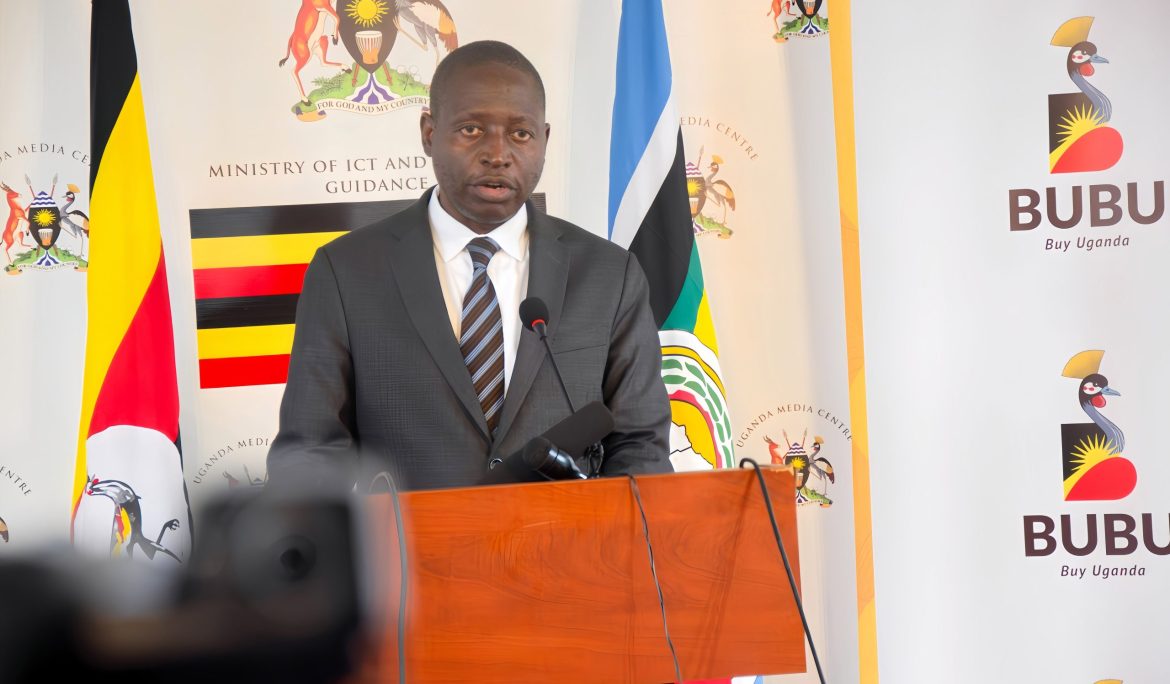
MEDIA STATEMENT BY THE MINISTER OF TRADE, INDUSTRY AND COOPERATIVES ON THE UPCOMING: WORLD ACCREDITATION DAY CELEBRATIONS 2025
Ladies and Gentlemen,
A very good morning to you.
I am honored to address you today on the eve of the commemoration of the World Accreditation Day 2025 in Uganda.
The World Accreditation Day (WAD) is a global initiative established by the International Laboratory Accreditation Cooperation (ILAC) and International Accreditation Forum (IAF), to raise awareness on the importance of accreditation amongst all relevant stakeholders. The day is celebrated in over 100 economies worldwide, represented by more than 100 accreditation bodies with the purpose of promoting accreditation.
This year, the World Accreditation Day shall be commemorated around the theme; Accreditation: Empowering Small and Medium Enterprises (SMEs). The theme highlights how accreditation and the broader quality infrastructure system can support and strengthen SMEs.
According to the World Trade Organization, nearly 95% of businesses worldwide are SMEs, most units employing less than 250 people each. However, they account for a greater share of employment in most economies, including the developed economies. In Uganda, the SMEs contribute to over 70% of the country’s GDP and provide nearly 90% of the employment in the various sectors such as agriculture, manufacturing, trade, and services.
Challenges faced by SMES:
Despite their vital role in global economies, SMEs face major challenges: competing with larger organizations, accessing finance, managing rising costs, bearing compliance burdens, and breaking into new markets.
The World Accreditation 2015 aims to raise awareness and shine a spotlight on the essential role accreditation plays in enabling SMEs to thrive in competitive markets while contributing to sustainable development goals.
Benefits of Accreditation:
- Accreditation ensures that businesses have greater confidence in the accuracy of the testing services, because they have been generated by facilities assessed as being competent.
- It minimises risks for business, as decisions will be based on reliable results. The rejection statistics of our products in export markets will reduce from USD 700m to USD 100m by 2030.
- It facilitates the free-trade goal of “accredited once, accepted everywhere” thereby granting access to international markets for our products.
Accreditation will improve our market penetration in the several regional blocks such as; the East African Community regional bloc with population of 343 million (2024 est) and GDP of $349bn (2024 est); The COMESA region with population of 640 million people (2024 est) and GDP of $1.0 trillion (2024 est); and The AfCFTA, with population of 1.3 billion people from the 54 member states and GDP of $3.4 trillion (2024 est).
Uganda’s current export figure stands at approximately USD 6bn. You may recall during the football World Cup held in Qatar in 2022, our beef products exports were rejected because the country did not have accredited halal certifications. With accreditation, there will be gains in halal products export to the Middle East, raising to USD 1.09bn by 2030. In 2024, our agriculture value chain export figure was USD 1.5bn and with accreditation, this is expected grow to USD 3.5bn by 2030. (Source: BoU, MFPED, UGANAS computations).
In Uganda, there are over 2,000 facilities providing testing and certification services. So far 125 of these facilities have been accredited by foreign accreditation bodies. It costs these facilities $10,000 dollars annually to maintain these accreditations, which is a high cost for business. Establishing the Uganda National Accreditation Service shall significantly lower the cost of accreditation by 35 to 40 percent.
Government of Uganda took keen interest as demonstrated by the development of the National Accreditation Policy 2014 and the enactment of the Accreditation Service Act 2021 that established the Uganda National Accreditation Service. I am glad to report that, as of 15th May 2024, Uganda’s National Accreditation Service attained Associate Member status with the African Accreditation Cooperation (AFRAC).
Government has established the National Accreditation Office at Makubya Road in Nakawa to provide accreditation services. In addition, UGANAS shall provide training services in the field of accreditation, which currently Ugandans are can only from abroad.
I am happy to inform the public that for the first time, accreditation services can now be provided directly through the UGANAS office or by visiting the website www.uganas.go.ug.
Thank you.
For God and My Country.